Late in the game between the Montreal Canadiens and the Utah Mammoth, we saw a strange officiating sequences.
TL;DR
- The Play: Montreal shot at Utah’s empty net. The puck hit the post and never crossed the goal line.
- The Call: A linesman called icing against Montreal.
- The Fix: Officials correctly voided the icing, moved the face-off to center ice, and allowed Montreal to change lines.
- The Cause: This was likely due to "Tunnel vision" on the hybrid icing race caused the linesman to miss the puck hitting the post.
What Happened on the Play
With Utah’s net empty, Montreal fired the puck down the ice. At this exact moment, the linesman is tracking the hybrid-icing race, looking to see if Utah’s defender reaches the end-zone face-off dot first.
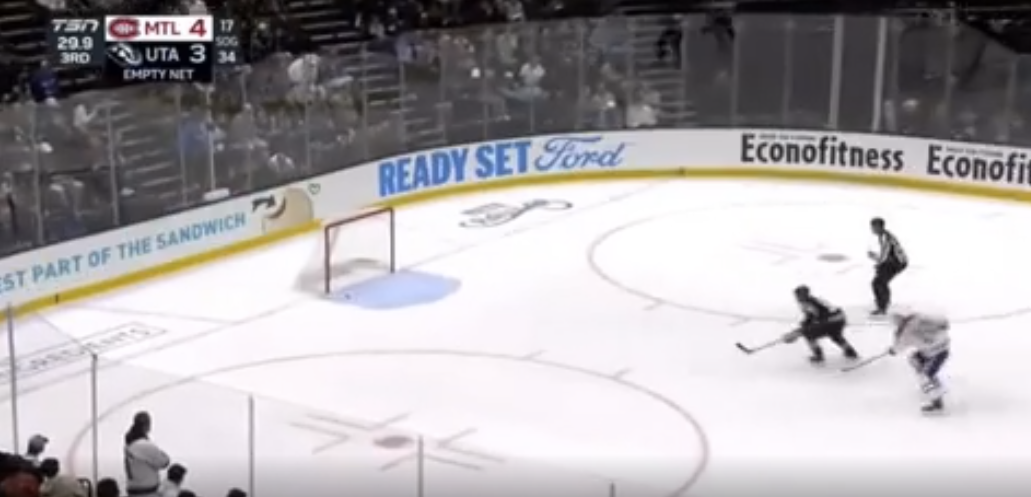
The critical split-second: The linesman is tracking the players reaching the dots while the puck is about to ring off the iron.
The shot rang off the post and deflected back out into play. Because the puck never crossed the goal line, icing cannot be called under NHL Rule 81. However, believing the puck was still on track to cross the goal line, the linesman blew the play dead for icing against Montreal.
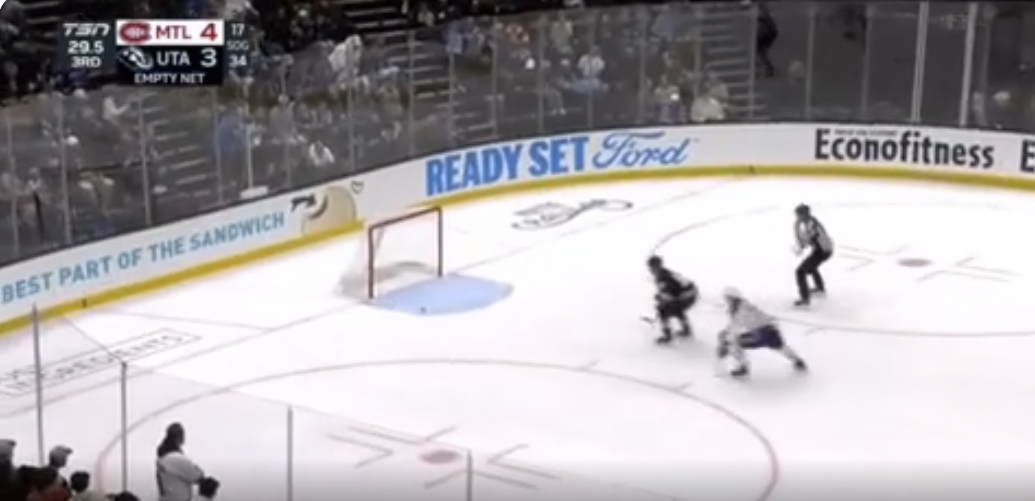
The aftermath: The whistle has blown, stopping the play despite the puck remaining live off the post.
Immediately afterward, the officials discussed the play, realized the puck hit the post before the whistle, and applied the correct cleanup procedure.
The Rulebook Context: Rule 81
Once the officials acknowledged the error, they followed the exact procedure outlined in the 2025-26 NHL Rulebook.
1. The Face-off Location
Because the linesman erred in stopping the play, the face-off was moved to center ice. This is explicitly covered in the rulebook:
Rule 81.2: “If the Linesperson shall have erred in calling an 'icing the puck' infraction (regardless of whether either team is short-handed), the puck shall be faced-off on the center ice face-off spot.” [cite: 1290]
2. The Line Change
Usually, an icing call prevents the offending team from changing players (Rule 81.4). However, because the icing was nullified as an error, that restriction was lifted. Montreal was allowed to change their tired group.
Why the Error Happened: Tunnel Vision and the Clock
This mistake wasn't about not knowing the rules; it was likely just human error due to the difficulty in watching 2 things at once during Hybrid Icing.
Hybrid icing requires linesmen to make two simultaneous, high-speed calculations:
- Trajectory: Will the puck cross the goal line?
- The Race: Who will touch the puck first (judged at the face-off dots)?
The timing is strict: the determination must be made no later than when the first player reaches the dot. In this case, that was Utah’s defender.
The "Last Minute" Factor
There is an added layer of pressure here that likely contributed to the error: Time Management. In the final minute of a game, the exact moment the whistle blows is crucial. If a review determines time needs to be added back to the clock, it is based on when the whistle sounded.
The linesman was likely hyper-focused on the exact moment the Utah defender reached the dot so he could blow the whistle instantly to preserve time for the trailing team. This created a "tunnel vision" scenario—he was so locked onto the player race and the timing of the whistle that his brain simply didn't process the visual cue of the puck hitting the post 300ms earlier.
Who Benefited?
While fans of both sides might argue they were robbed, the result of the error was mixed:
Montreal's Perspective:
- If the play had continued, the puck was live off the post. They might have been able to contain Utah in their zone or at least take more time off the clock.
Utah's Perspective:
- They had control of the puck but instead had to do a face-off at center ice. They were attacking 6-on-5 and Montreal needed a change, so they could have made a quick pass up the ice and caught the tired Montreal players on a change. They also had to put their goalie back in for the center-ice draw, losing the extra attacker advantage.
As much as I like complaining about officiating, looks like this was a millisecond processing error driven by the safety rules of hybrid icing. The crew fixed it by the book, resulting in a center-ice draw. Montreal ended up preventing Utah from scoring in those last 30 seconds to win the game.